
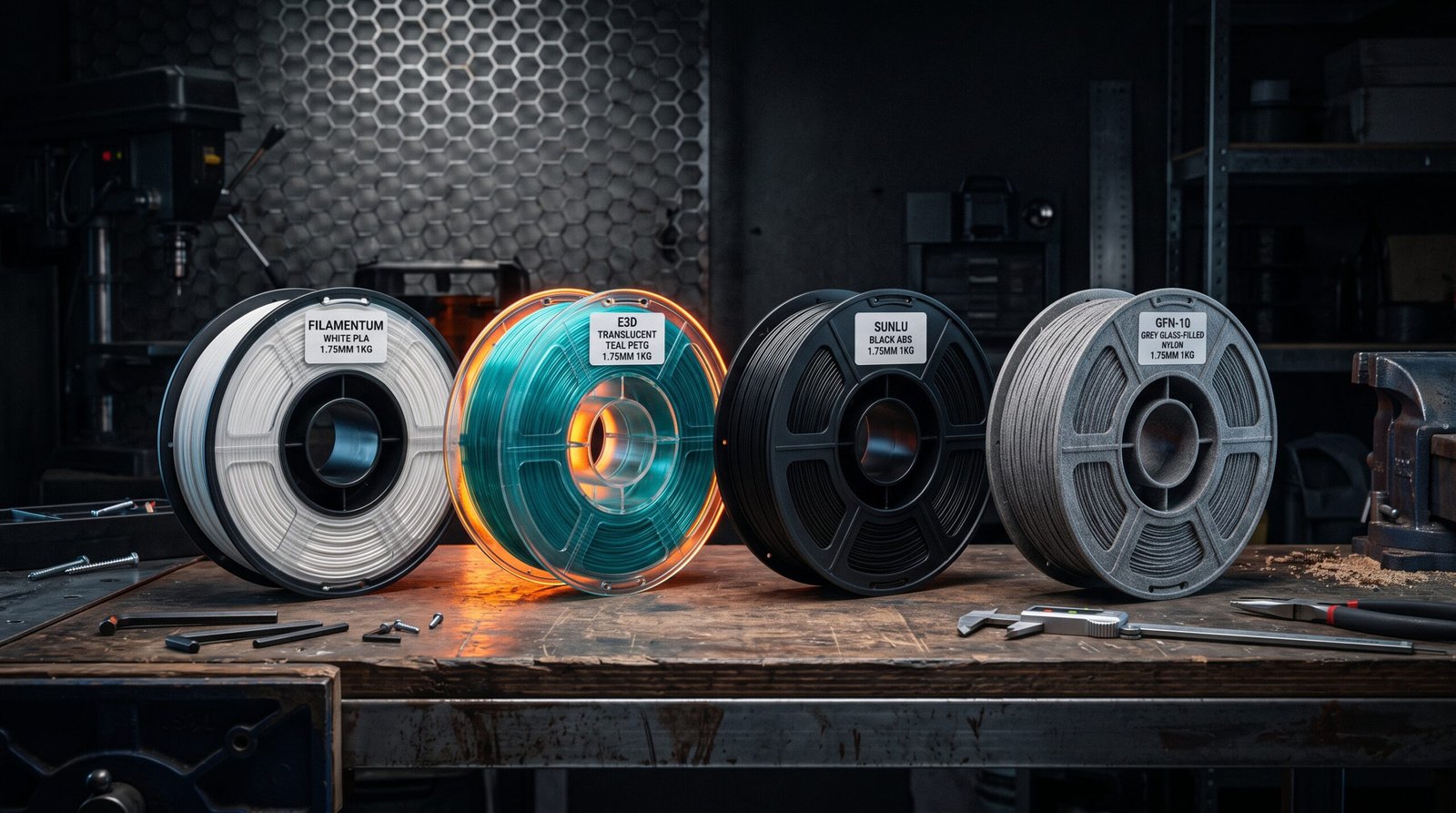
Here’s a question we get almost every week at UNBRAND3D, whether it’s a homeowner looking to replace an obsolete appliance part or a Midlands engineer sourcing a load-bearing bracket:
The short answer is: it depends entirely on what the part needs to survive. Print with the wrong material and you’ll get a part that looks flawless on the build plate but snaps the first time it’s put to work. At our shop in the Sand Hills area of Columbia, we match the physical and thermal demands of your application to the exact filament chemistry.
The 4 Core 3D Printing Materials: Breakdown & Trade-Offs
1. PLA (Polylactic Acid)
Best For Visuals & Rapid PrototypesPLA is where most 3D printing projects begin. It is dimensionally stable, odorless, prints with virtually zero warping, and offers the widest variety of colors and surface finishes.
2. PETG (Polyethylene Terephthalate Glycol)
The Functional Household WorkhorsePETG is the standard material we reach for when a part needs to survive actual everyday use. It blends the ease of PLA printing with impact resistance, flexibility, and chemical durability.
3. ABS / ASA (High Temperature & UV)
Automotive & High Thermal ResistanceABS is the exact thermoplastic used in injection-molded products, power tool casings, and vehicle interiors. It offers high heat deflection and superior impact toughness.
4. Nylon & Carbon Fiber (PA-CF)
Industrial Grade & Zero FailureWhen a part cannot fail under continuous industrial stress, we turn to Carbon Fiber Reinforced Nylon (PA-CF). It delivers exceptional tensile strength, friction resistance, and heat tolerance.
Quick Material Selection Matrix
| Filament | Impact Strength | Heat Deflection | Best Environment |
|---|---|---|---|
| PLA | Low / Brittle | Low (~60°C) | Indoor Display & Concept Testing |
| PETG | Moderate / Flexible | Moderate (~75°C) | Daily Home & Utility Repairs |
| ABS / ASA | High / Rigid | High (~100°C) | Automotive & Outdoor UV Exposure |
| Nylon (PA-CF) | Extreme / High Wear | Very High (150°C+) | Continuous Mechanical & Industrial Stress |
Not Sure Which Material Fits Your Part?
You don’t need to be a materials engineer. Drop by our Sand Hills lab or send over your specifications, and we’ll recommend the exact filament for your project.
Request a Free Quote & Material Review →